
Old vs New Tax Regime - Which One Should You Choose in FY 2024-25?
The introduction of the new tax regime under Section 115BAC has given taxpayers a choice: stick with the traditional method (with deductions and exemptions) or opt for lower tax rates with no deductions. But how do you know which one is best?
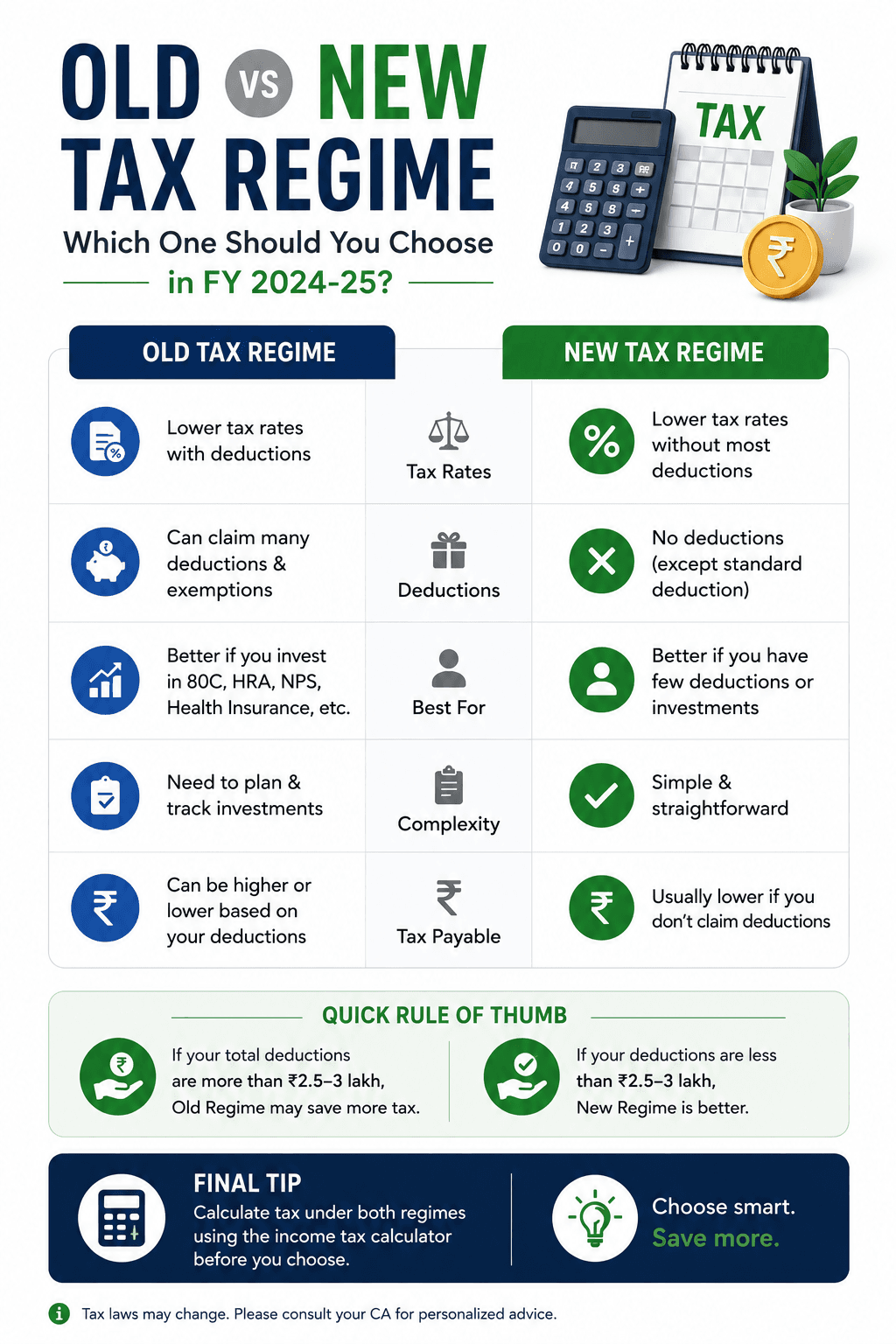
The era of dual tax regimes continues for another year in India. The traditional method of deductions and exemptions co-exists with the new lower-rate regime, and the choice you make influences how much income tax you pay for FY 2024-25.
Quick Comparison: Old vs New Regime
| Income Slab | Old Regime (with deductions) | New Regime (without deductions) |
|---|---|---|
| Up to ₹3 lakh | Nil | Nil |
| ₹3 lakh – ₹6 lakh | 5% | 5% |
| ₹6 lakh – ₹9 lakh | 20% | 10% |
| ₹9 lakh – ₹12 lakh | 20% | 15% |
| ₹12 lakh – ₹15 lakh | 30% | 20% |
| Above ₹15 lakh | 30% | 30% |
- The new regime offers lower rates but no deductions (80C, 80D, 24B, 10(13A), etc.)
- The old regime comes at higher tax rates but offers a host of tax-saving deductions
When Should You Choose the New Tax Regime?
- You're not eligible for major investment deductions
- Your investment scope is low (few 80C, ELSS investments)
- Your salary is simple/flat without components that qualify for exemptions
When Is the Old Regime Better?
- You utilize all major tax breaks available
- You claim HRA, standard deduction, and 80C/80D benefits
- Your salary structure with allowances gets optimal tax exemptions
Updates for FY 2024-25
- The new tax regime is now the default (you can opt out/in)
- The standard deduction under the new regime increased to ₹75,000
- Rebate under Section 87A now extends up to ₹7 lakh in the new regime
- Corporate tax remains at 22%
Example Comparison
Annual Salary: ₹12,00,000. Total investments under all eligible sections: ₹2,50,000.
| Aspect | Old Regime | New Regime |
|---|---|---|
| Tax Payable (after rebate) | ₹84,500 | ₹65,000 |
| Effective Tax Saving | More if eligible for higher deductions | ₹19,500 |
Note: If you're eligible for deductions of more than ₹2.5L, the old regime usually becomes more beneficial.
Final Thoughts
There's no one-size-fits-all answer. Choosing the right tax regime depends on your income structure and deduction potential. Consider house rent allowance vs. self-accommodation and the availability of multiple investments before selecting.
Frequently Asked Questions
What is the major difference between old and new tax regimes?
The old regime allows deductions and exemptions, while the new regime offers lower tax rates but no major deductions.
Is the new regime compulsory for all?
No. It's the default from FY 2023-24 onward, but you can still opt for the old regime.
Can I switch between regimes every year?
Yes, salaried individuals can switch every financial year. Business owners can switch only once.
Does the new regime allow any deductions at all?
Yes, a standard deduction of ₹50,000 and employer NPS contribution deduction are allowed from FY 2023–24.
Which regime is better for salaried employees?
It depends. If your total deductions are over ₹3 lakh, the old regime usually works better.
Can I claim HRA and 80C in the new regime?
No. Most common deductions, including HRA, 80C, 80D, LTA, are not allowed in the new regime.
What is the rebate limit in the new regime?
Under Section 87A, individuals with income up to ₹7 lakh get a full tax rebate in the new regime.
Can high-income earners benefit from the new regime?
Yes. Due to capped surcharge at 25%, those earning above ₹5 crore may pay less tax in the new regime.
Will ITR filing be different based on the regime I choose?
No, the filing steps remain the same. But you'll need to declare your regime choice while filing.
Can TaxSavvy help me decide the best tax regime?
Definitely. We compare both regimes based on your inputs and guide you toward the most tax-saving option.