
Who Should File Income Tax Return (ITR) for FY 2024-25 (AY 2025-26)
When it comes to taxes, many individuals are unsure whether they even need to file an Income Tax Return (ITR). While not everyone is obligated to file, certain conditions mandate it—even if your income falls below the basic exemption limit.
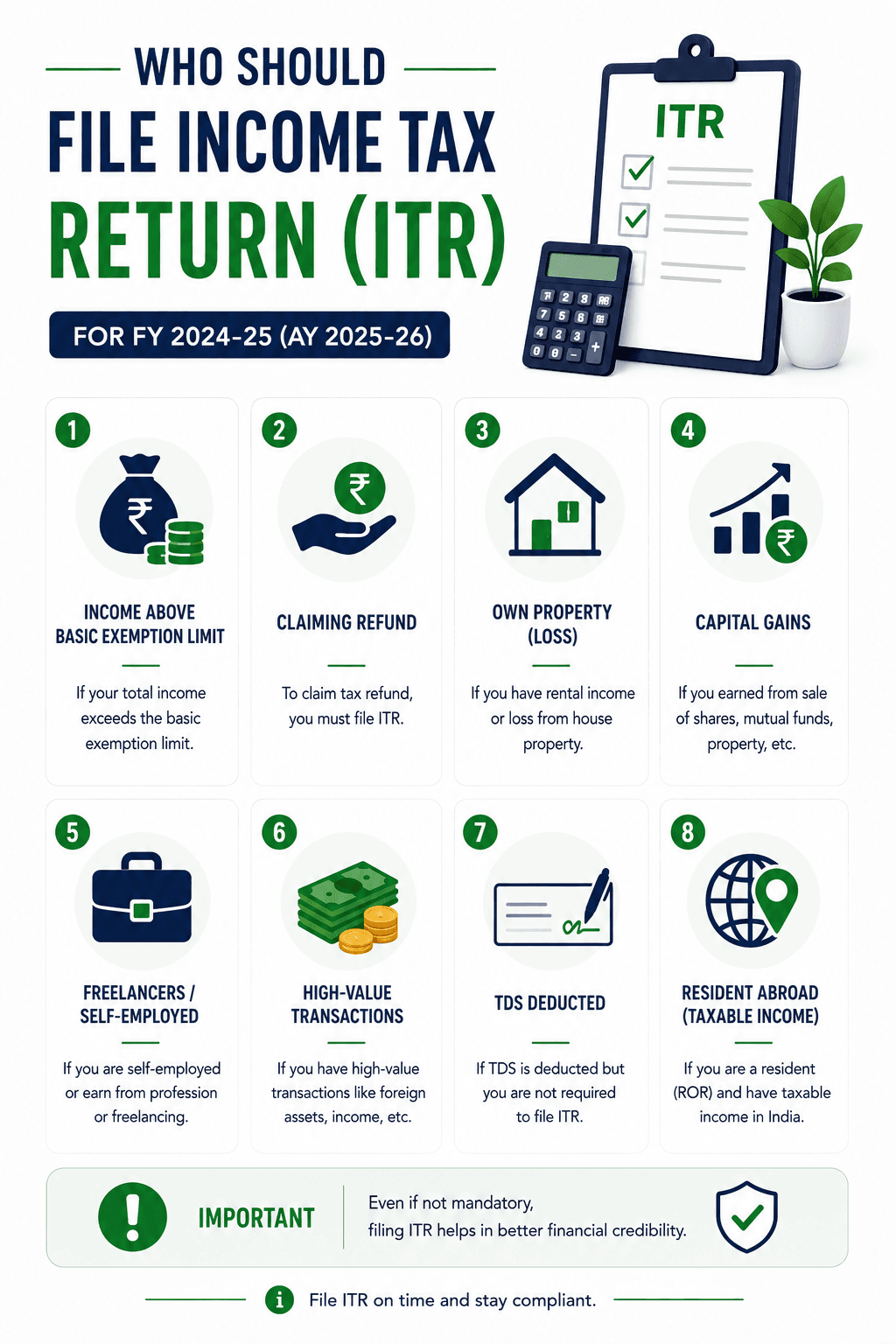
When it comes to taxes, many individuals are unsure whether they even need to file an Income Tax Return (ITR). While not everyone is obligated to file, understanding your tax requirements is essential for financial compliance. Filing your ITR is not just about compliance; it can also unlock benefits such as faster loan approvals, visa applications, and tax refunds.
Here's a simple breakdown to help you understand who must file an ITR for the current financial year:
Mandatory ITR Filing – Who Needs to File?
1. If your total income exceeds the basic exemption limit:
| Age Category | Income Threshold |
|---|---|
| Below 60 years | ₹2.5 Lakhs |
| Senior Citizens (60-80 yrs) | ₹3.0 Lakhs |
| Super Senior Citizens (80+) | ₹5.0 Lakhs |
2. Other Scenarios That Require ITR Filing:
Even if your income is below the threshold, you're still required to file an ITR if:
- You want to claim a tax refund.
- You have foreign assets or income.
- You've deposited over ₹1 crore in one or more current accounts.
- You've spent over ₹2 lakh on foreign travel, or over ₹1 lakh on electricity bills.
- You're earning income from properties outside India.
- Your professional receipts exceed ₹10 lakh.
- Your TDS/TCS exceeds ₹25,000 in a year (₹50,000 for senior citizens).
The government has made this mandatory under notification to increase transparency.
NRIs – Do You Need to File?
If you are a Non-Resident Indian (NRI) and your income in India exceeds ₹2.5 lakh (including capital gains), you're required to file ITR—regardless of your residential status.
For NRIs with income sources or owned property inside India, this rule is not just mandatory—it's also beneficial for claiming refunds and avoiding legal penalties.
Why Should You File ITR?
Even if it's not compulsory, here's why filing is still a smart move:
- Proof of income for loan applications.
- Essential for visa applications.
- Lets you carry forward capital losses.
- Establishes financial credibility.
Penalties for Missing the Deadline
Missed the due date (typically 31st July)? If your income is:
- Below ₹5 lakh: Penalty up to ₹1,000
- Above ₹5 lakh: Penalty up to ₹5,000
Final Thoughts
Filing your ITR is more than just a legal requirement—it's a strategic financial decision. Whether you're a salaried professional, self-employed, or an NRI, timely ITR filing gives you a financial edge.
TaxSavvy is here to simplify the process. Whether you're unsure about your filing status or want an expert to handle your taxes end-to-end, we've got you covered.
Frequently Asked Questions
Who is required to file an Income Tax Return (ITR) for FY 2024-25?
Anyone whose total income exceeds the basic exemption limit or meets specific criteria like high-value transactions, foreign assets, or TDS deductions.
What is the basic exemption limit for FY 2024–25?
₹2.5 lakh for individuals below 60 years, ₹3 lakh for those between 60–80 years, and ₹5 lakh for individuals above 80 years.
I am a student with income from freelancing. Do I need to file an ITR?
Yes, if your total income exceeds ₹2.5 lakh or you meet other conditions like high-value bank deposits, TDS deduction, or foreign income.
Is it mandatory for NRIs to file ITR?
Yes, if their income earned or received in India exceeds ₹2.5 lakh or involves capital gains and rental income.
Can I file ITR voluntarily even if my income is below the threshold?
Absolutely. It's beneficial for claiming refunds, establishing income proof, and applying for loans or visas.
What happens if I don't file my ITR on time?
You may be charged a late filing penalty up to ₹5,000 and miss out on important financial benefits like loss carryforward or refunds.
Is there any benefit to filing ITR even if I don't owe taxes?
Yes, you can claim TDS refunds, build financial records, and use your ITR as income proof for various applications.
What are the consequences of non-filing if I meet the mandatory conditions?
The Income Tax Department may issue notices, levy penalties, and initiate legal action in case of non-compliance.
Can I file my ITR after the deadline?
Yes, you can file a belated return by December 31st of the assessment year, but penalties may apply.
Does filing ITR help with visa applications and credit approvals?
Definitely. Consistent ITR filing reflects financial credibility and is often required for visa processing and securing credit.